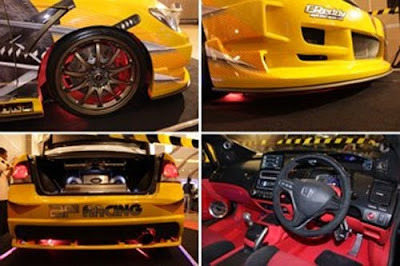
Modification concept of this car is the "Elegant Style". Bodykit used is Noblesse as well as the sector light. On the roof mounted Webasto Holland Freedom Roof 500 Panasonic width that makes more elegant appearance. At the foot rim is used Bvllens TS06 18" and tires Toyo Proxes T1R 215/35/18 with Air Suspension Bolt on Airbomber output GE8. To boost engine performance used Simota CF air intake and carbon engine cover BK20a.
Honda Jazz Elegant Concept with Noblesse Kits via Situsotomotif
Dashborad-Honda Jazz Elegant Concept with Noblesse Kits via Situsotomotif
Audio-Honda Jazz Elegant Concept with Noblesse Kits via Situsotomotif
For audio entrusted to Double Pin Head Unit Alpine DVA 9861 coupled with PXA processor H-701. Craig David Acoustic speakers and Abyss speakers combination with subwoofer FA1 10 "make the car theater system is perfect.
Detail Modification :
Owner :Anthony
Exterior :
Noblesse Lux Japan original body kit
Custom wide body natural
Foglamp by Noblesse Japan
Side mirror s class blinker
Noblesse twin exhaust original
Custom trunk lid Noblesse
Tailamp Fit RS custom to Mercedes S class style
Chrome lis body 7mm & 12mm by Noblesse original
Emblem Noblesse original (bonnet, pilar c & rear emblem)
Concept of this Honda Nova is "Speed Racer" and "Concept Car Design". This car body is made by hand with galvanized material thickness 0.6-0.8 meters. The design "classic speed racer cars" can seen in the numbers with black and white lines from the trunk until bonet with car number in the middle of bonet and body side.
Honda Nova Speed Racer via HIN Magz
Engine-Honda Nova Speed Racer via HIN Magz
Dashboard-Honda Nova Speed Racer via HIN Magz
Whereas the "concept car design" can seen in the design of strong lines, such as the rear bumper to negotiate a triangle design. The roof of the car is designed to integrate between Honda Nova and the Honda CR-X Delsol with custom touches that give a good aerodynamics. Another provided on this car is air suspension ground clearance that make this car can go down the road even with extreme views.
Learn the technical specifications of the 2010 Honda Accord Sedan. Get interior, exterior and engine specifications for the 2010 Honda Accord Sedan.
Engine Specifications
dohc I41
dohc I42
sohc V63
Size, liters/cu. in.
2.4/144
2.4/144
3.5/212
Horsepower @ rpm.
177 @ 6500
190 @ 7000
271 @ 6200
Torque (lb-ft) @ rpm.
161 @ 4300
162 @ 4400
254 @ 5000
Availability
Standard
Standard
Standard
EPA City / highway mpg
5-speed manual
22/31
22/31
--/--
5-speed automatic
21/31
21/31
19/29
1. LX, LX-P. 2. EX, EX-L. 3. EX V6, EX-L V6.
Engine Key: l/cu in. = liters/cubic inches; ohv = overhead valve; ohc = overhead camshaft; dohc = dual overhead camshaft; I = inline cylinders; H = horizonally opposed cylinders; V = cylinders in a V configuration; W = cylinders in a W configuration; rpm = revolutions per minute; CVT = continuously variable (automatic) transmission; NA = not available; "--" = measurement does not exist.
Honda Siel Cars India Ltd. (HSCI), a leading manufacturer of premium cars in India, unveiled the world premiere of the Honda New Small Concept, a concept model for a new small-sized vehicle. Thye HSCI also announced plans to begin sales of a new model in 2011 based on this concept model. For the Honda New Small Concept, a wide platform with a stable center of gravity was adopted to create a highly efficient compact size with seating for five people. With the "Efficient Energetic Exterior" design, the dynamic design of the Honda New Small Concept with front forward fenders highlight the presence of the vehicle.
The Honda will strive to provide a new small-sized vehicle that is beyond the expectations of customers in rapidly growing markets and offer it at an affordable price by leveraging Honda's global parts sourcing network.
The Honda P-NUT Concept (Personal-Neo Urban Transport) demonstrates a futuristic concept for an ultra-compact and sophisticated city coupe.
Conceived around a small "footprint" for maximum convenience in tight urban settings, the packaging concept integrates a center driving position configuration and a rear powertrain layout. The exterior styling leverages crisp angles with dynamic flowing lines that originate from the front of the vehicle and span outward toward the rear. The end result is a sleek and aggressive exterior that also allows for a spacious and open interior with excellent visibility.
"A new generation is discovering the benefits of living in urban centers that provide convenient access to business, entertainment and social opportunities," said Dave Marek, director of advanced design for Honda R&D Americas, Inc. "The Personal-Neo Urban Transport concept explores the packaging and design potential for a vehicle conceived exclusively around the city lifestyle."
The exterior styling is intended to capture a future direction for premium sophistication while balancing the need for maximum interior space and an aerodynamic appearance. The interior layout, in conjunction with the rear powertrain design, contributes prominently to the exterior's overall shape.
The layout of the interior space, with its center driving position flanked by two rear seats, provides generous legroom for all occupants, roughly the equivalent of a mid-sized sedan in a vehicle that has an exterior footprint similar to a micro car. Interior functionality is increased by rear seating areas that fold up and out of the way to increase storage capacity. The windshield serves as a heads-up display for the navigation system and the back-up camera. The modular rear engine bay, depicted on the exterior by blue composite material, is designed to accommodate a wide variety of potential propulsion technologies including a conventional small displacement internal combustion engine, a hybrid gasoline-electric powertrain, or a battery-electric powertrain.
"The objective of the exterior and interior designers was to explore the potential for a new type of small-segment-category vehicle that overcomes many of the objections for existing micro-car designs," said Marek. "While the Honda P-NUT Concept introduces function-oriented concepts, it also shows that small cars don't have to compromise on style or amenities." The Advanced Design Studio of Honda R&D Americas, Inc. in Los Angeles developed the Honda P-NUT Concept. Honda R&D Americas began its operations in California in 1975 with local market research activities and has steadily grown its capabilities over the past 33 years to include all aspects of new vehicle research, design and development. Recent Honda-brand efforts include trend-setting products such as the Pilot, Ridgeline, Element, Civic Coupe and Civic Si Coupe.
Specifications = Size class: Ultra-compact = Layout: Rear-engine, rear-wheel-drive = Passengers: 3 = Length: 3,400 mm = Width: 1,750 mm = Height: 1,439 mm = Powertrain: Internal-combustion engine, hybrid-electric or battery-electric
The prototype conveys the design features of the more boldly-styled 2009 Pilot, which emphasizes authentic SUV styling, clever and more accommodating interior packaging and advanced technologies for safety, fuel efficiency and convenience. The functional eight-passenger seating, a hallmark of the Pilot, becomes even easier to access in the third row as key dimensions for legroom, cargo and occupant space increase in all seating positions. A redesigned platform allows even more refined handling and ride comfort to exist seamlessly with all-weather and medium-duty off-road capabilities. The Pilot will feature the Honda-exclusive Advanced Compatibility Engineering™ (ACE) body structure and the most extensive use of high-strength steel in any Honda product to date. The ACE body structure enhances frontal collision compatibility with vehicles of different sizes and bumper heights. A pedestrian injury mitigation design in the front of the vehicle is designed to help absorb energy in the event of a collision. A crossover SUV platform underpins the Pilot to provide the best of the car and truck worlds by integrating the refined traits and packaging advantages of a unit body car design with the utility and capability of an SUV design. A V-6 engine introduces the latest generation of Honda fuel-saving Variable Cylinder Management™ (VCM®) technology that operates in 6-cylinder mode for power and 4- and 3-cylinder modes for efficiency, an improvement compared to the existing Pilot's available VCM system that works exclusively in 6- and 3-cylinder modes.
The three rows of seats provide a high degree of adaptability for people and large cargo loads. The first row provides a commanding view of the road from two captains' chairs. A wide center stack and center console form the styling anchor for the interior with a design that emphasizes spaciousness and power, while allowing for convenient access to navigation, entertainment and climate-control systems. The 60/40 split second row, more spacious, slides further forward for increased ease of access to the third row. The 60/40 split third row, now supplies enough knee room for an above-average-sized adult male to fit comfortably, making the Pilot's third row among the most practical in the industry. Each side of the second and third row independently folds down for cargo. A flat floor is created when the second and third rows are folded down. Among its numerous accolades, the Honda Pilot has earned Car and Driver Magazine's prestigious "5Best Truck" award on six consecutive occasions (2002-2007).




 The Honda P-NUT Concept (Personal-Neo Urban Transport) demonstrates a futuristic concept for an ultra-compact and sophisticated city coupe.
 The modular rear engine bay, depicted on the exterior by blue composite material, is designed to accommodate a wide variety of potential propulsion technologies including a conventional small displacement internal combustion engine, a hybrid gasoline-electric powertrain, or a battery-electric powertrain.
 The Advanced Design Studio of Honda R&D Americas, Inc. in Los Angeles developed the Honda P-NUT Concept. Honda R&D Americas began its operations in California in 1975 with local market research activities and has steadily grown its capabilities over the past 33 years to include all aspects of new vehicle research, design and development. Recent Honda-brand efforts include trend-setting products such as the Pilot, Ridgeline, Element, Civic Coupe and Civic Si Coupe.


